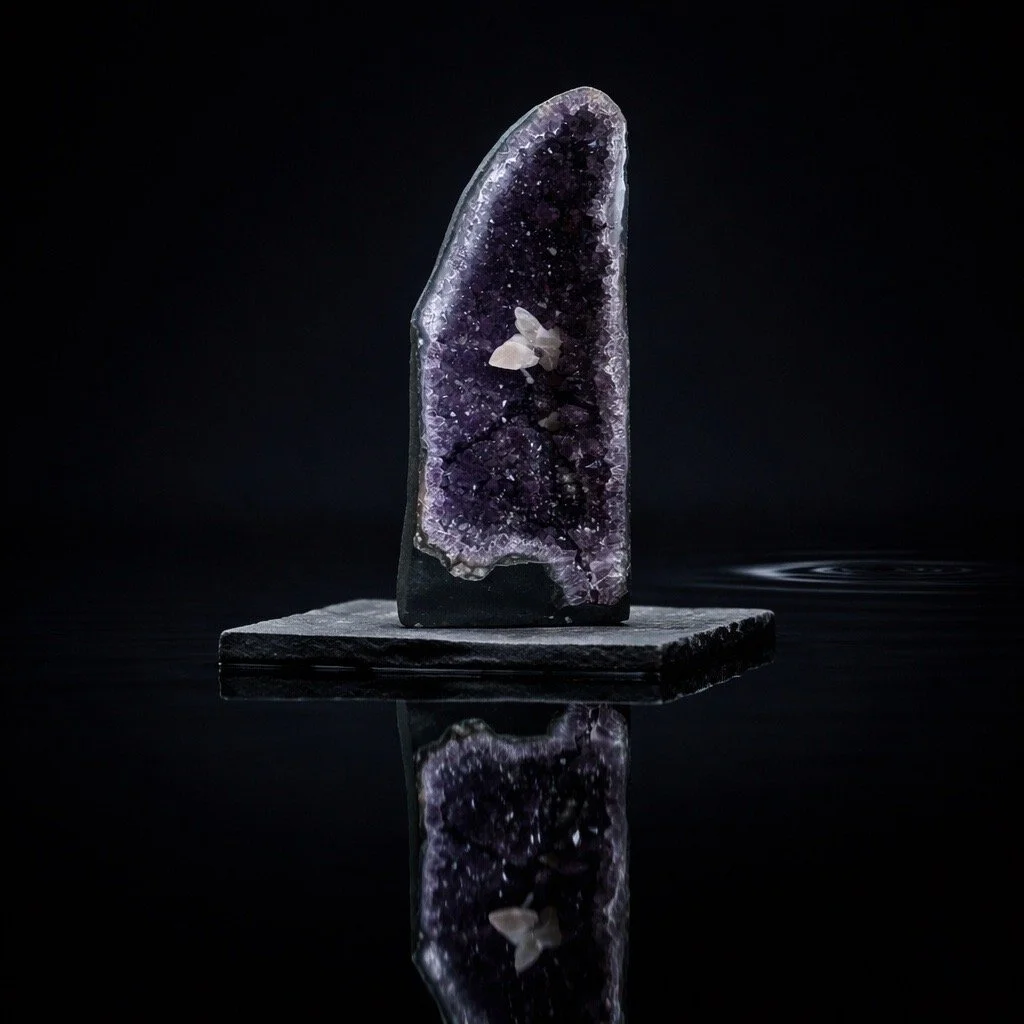
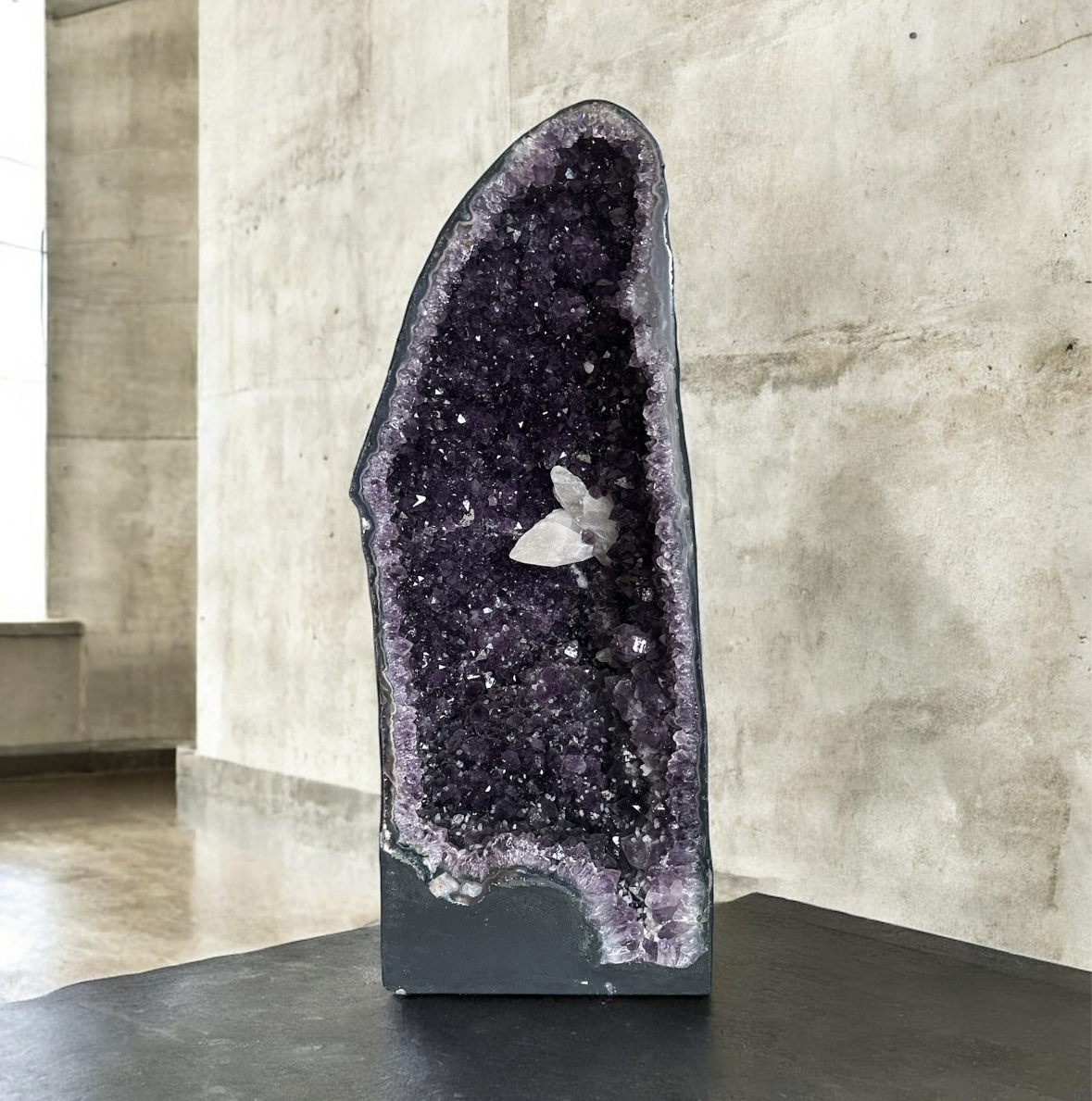
Amethyst Geode “Cathedral”
A natural amethyst cathedral, a tall, hollow geode lined with deep purple quartz crystals. The elongated, vertical form, resembling a Gothic arch, is characteristic of so-called “cathedral” geodes, a term used when the cavity is tall and narrow.
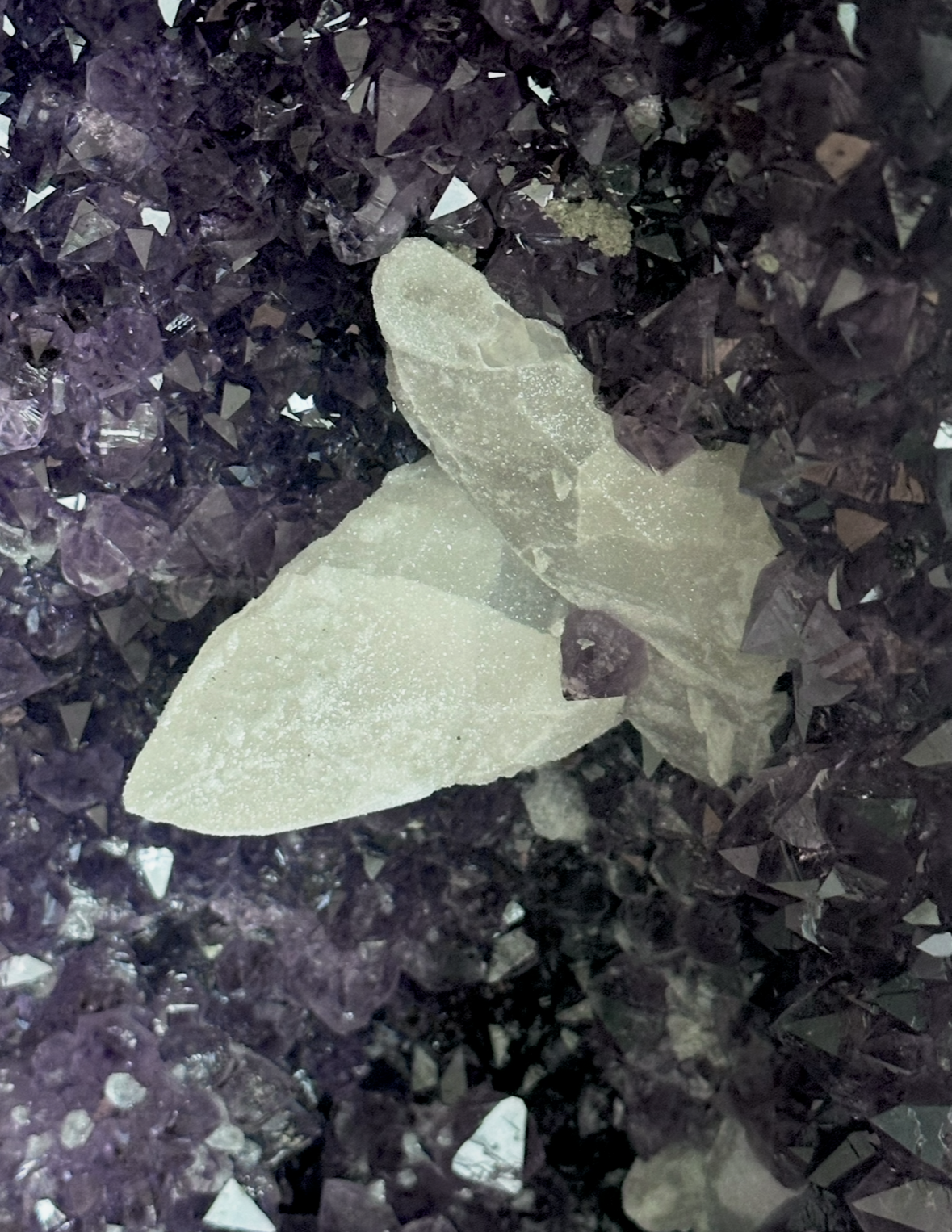
The interior displays a dense crystallization of violet to dark purple amethyst points with a vitreous (glassy) luster. In the central zone, a contrasting white crystalline formation (likely calcite) adds visual depth and mineralogical interest. The outer rim shows a typical chalcedony/agate band, forming the transition between the host rock and the crystal cavity.
The base and back are cut and reinforced to allow stable display, standard practice for large Brazilian cathedrals.
Chemical & Mineralogical Identity
Mineral name: Amethyst (variety of quartz)
Chemical formula: Silicon dioxide (SiO₂)
Crystal system: Trigonal
Hardness: 7 (Mohs scale)
Color origin: Iron (Fe) impurities combined with natural irradiation create the purple color centers in the crystal lattice
Amethyst is part of the quartz group, composed of a three-dimensional silica framework that gives it durability and brilliance.
Origin & Geological Context
This cathedral originates from southern Brazil, most likely the Rio Grande do Sul region, one of the world’s primary sources of large amethyst geodes.
These deposits formed within the Paraná volcanic basalt province, one of the largest lava outpourings in Earth’s history.
Formation Process (How It Forms)
Amethyst cathedrals form through a multi-stage geological process:
Gas Bubble Formation
Cavities (vesicles) develop in cooling basaltic lava flows.Sealing & Chalcedony Lining
Silica-rich fluids enter the cavity and deposit a layer of chalcedony (microcrystalline quartz) along the walls.Crystal Growth
Over time, quartz crystals grow inward from the cavity walls, forming pointed terminations toward the center.Color Development
Trace iron incorporated during growth is altered by natural radiation, producing the characteristic purple color.
Formation temperatures are relatively low (often below 100 °C), indicating slow crystallization from mineral-rich fluids.
Historical & Cultural Background
Amethyst has been valued for thousands of years:
Ancient Greece: believed to prevent intoxication (name derives from “amethystos”, meaning “not drunk”)
Ancient Egypt: used in jewelry and carved amulets
Medieval Europe: worn by soldiers and clergy for protection and clarity
Large Brazilian geodes, including cathedral forms, became widely known after major discoveries in the 18th–19th centuries, which significantly increased global availability.
Art. nr. Amethyst Cathedral 010
Size: 60,5 × 24 x 25 cm
Weight:
Origin: Brazil
Price € 1800,—