EGYPTIAN BRONZE STATUETTE OF THE GOD ANUBIS
Late Period, 26th - 30th Dynasty, ca. 664 - 332 BC
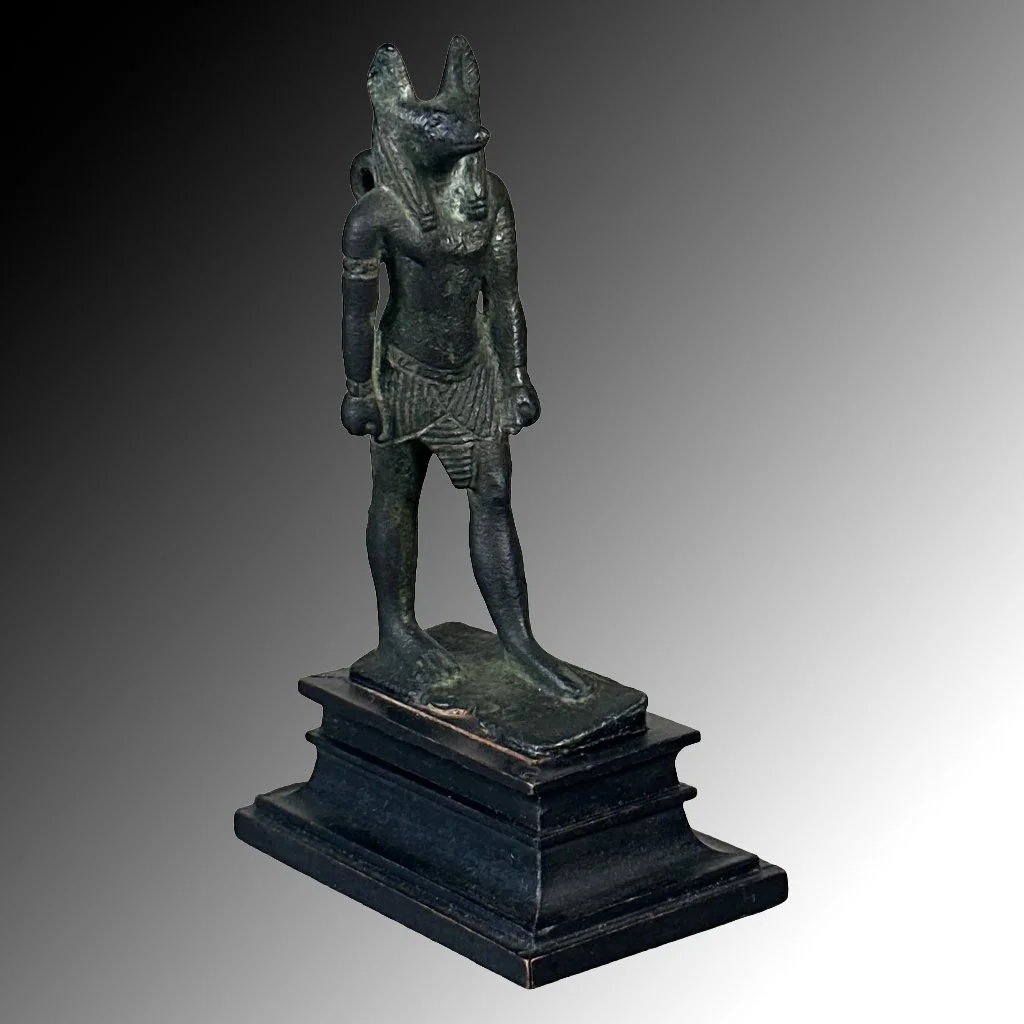
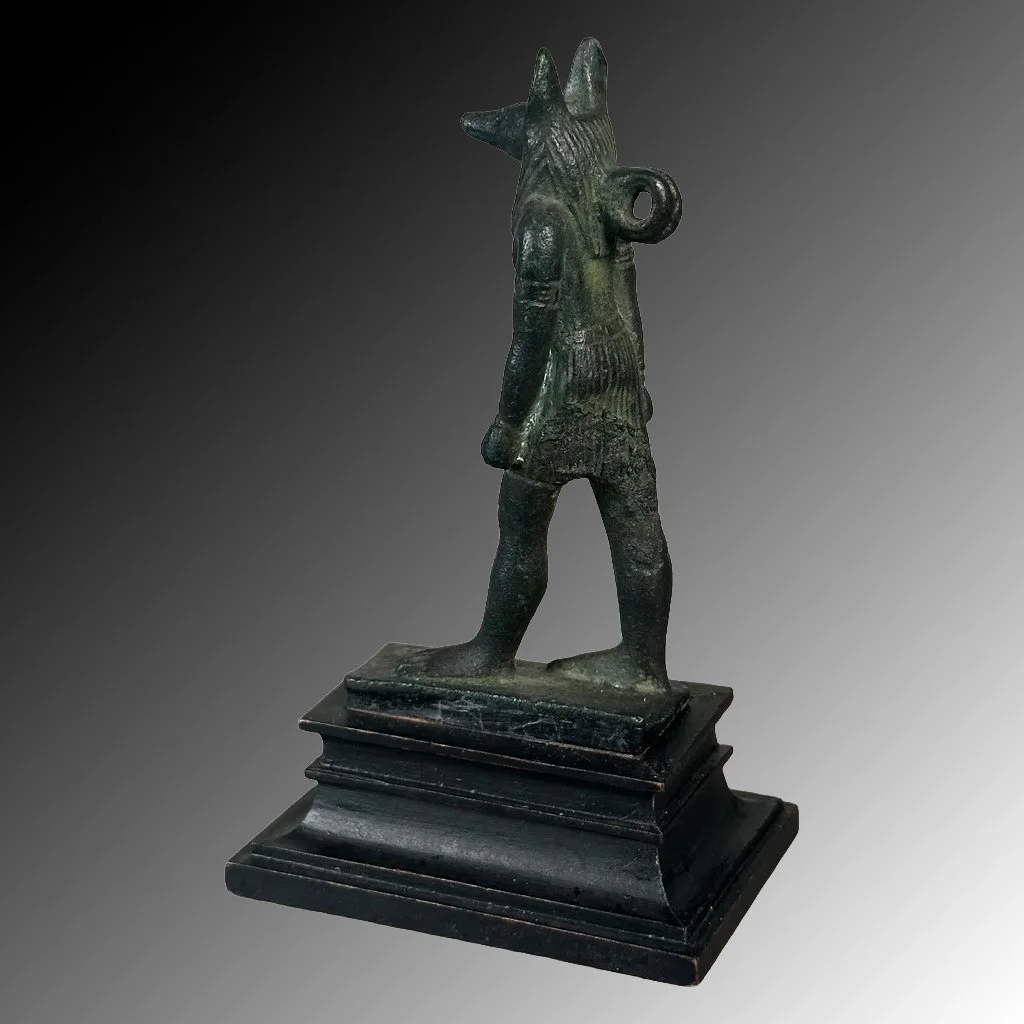
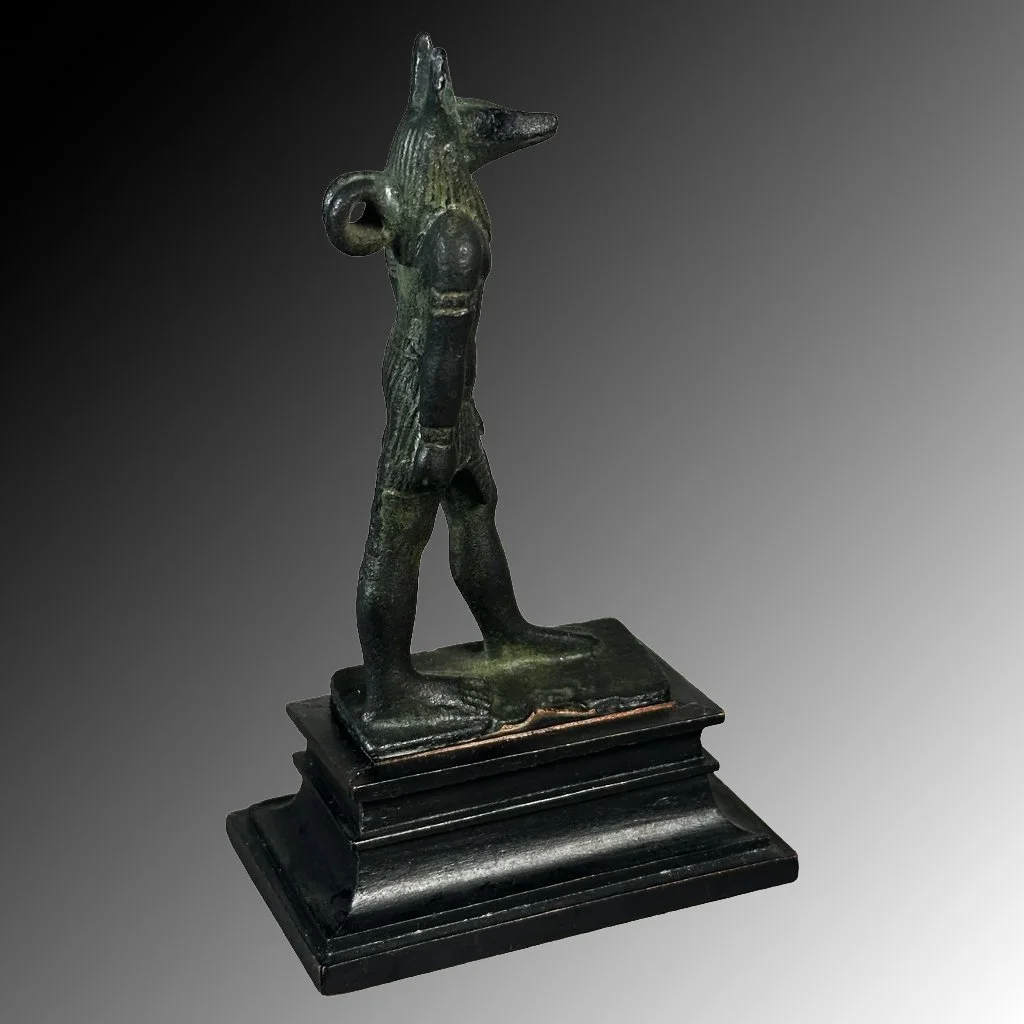
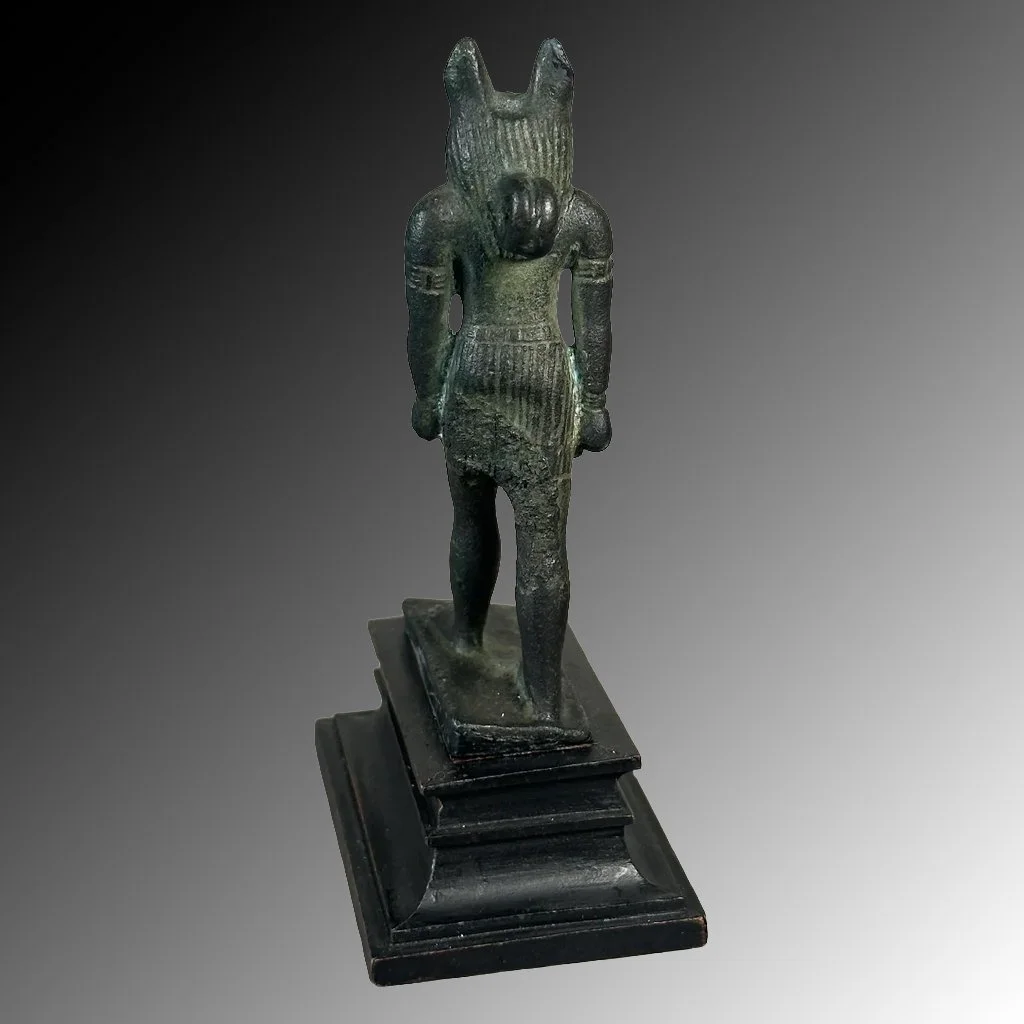
Material: Solid cast bronze, dark green-black patina with cuprite highlights.
Dimensions: 9.7 cm without base; 12 cm incl. modern display base
Provenance: Private French collection, 1990's; Acquired from G&M, Germany.
Condition: Intact and very good. Minor surface pitting and encrustation consistent with age. Stable patina. Mounted on a custom black wooden pedestal base.
DESCRIPTION:
A fine Egyptian votive bronze depicting the god Anubis in his fully anthropomorphic form, striding forward in the conventional pharaonic pose with the left leg advanced on a thin integral plinth.
The deity is shown with the characteristic jackal head with tall, erect ears and elongated muzzle, wearing the striped nemes-style wig and a short pleated shendyt kilt with incised detailing. The chest preserves traces of a broad collar, and the upper arms are adorned with armlets. The arms are held rigid at the sides with clenched fists, a pose denoting divine authority and protection.
On the back, just below the wig, a large cast suspension loop is preserved. This is typical for Late Period bronzes and indicates the statuette was worn as a pectoral amulet by a priest or suspended within a shrine or sacred barque as a devotional offering.
The casting is hollow? No, solid lost-wax cast of good quality for the period, with crisp details in the head and drapery.
THE GOD ANUBIS - Historical Background:
Anubis, Egyptian Anpu or Inpu, is one of the oldest and most iconic gods of the Egyptian pantheon. Originally the god of the necropolis and chief protector of graves, he is associated with mummification and the afterlife.
Depicted as a black jackal or as a man with a jackal's head, his black color symbolized both the discoloration of the corpse after embalming and the fertile black silt of the Nile, representing rebirth. His primary roles were:
Guardian of Tombs: He protected graves from desecration.
God of Embalming: According to myth, Anubis embalmed Osiris himself, becoming the patron of embalmers.
Guide and Psychopomp: He guided the souls of the dead to the Hall of Truth and was present at the Weighing of the Heart ceremony, protecting the deceased during the judgment before Osiris.
From the Late Period onwards, especially during the 26th Dynasty, there was an explosion in mass production of bronze votive statuettes. Pious pilgrims would purchase them at temple workshops and donate them to temples as offerings to the gods to secure their favor. Deities like Anubis, Osiris, Isis, and Bastet were particularly popular. They were deposited in vast quantities in temple caches.
DATING & PARALLELS:
This type of striding Anubis with a back suspension loop is characteristic of the Late Period. The stylistic features - the slender proportions, the finely pleated kilt, and the well-modeled jackal head - fit securely into the 26th-30th Dynasty horizon. Compare to examples in the Louvre (E 11657), British Museum (EA 60039), and the Musée d'Art et d'Histoire de Neuchâtel.
A highly collectible and instantly recognizable piece of Egyptian devotional art, in excellent collectible condition.
Price € 5.750,—