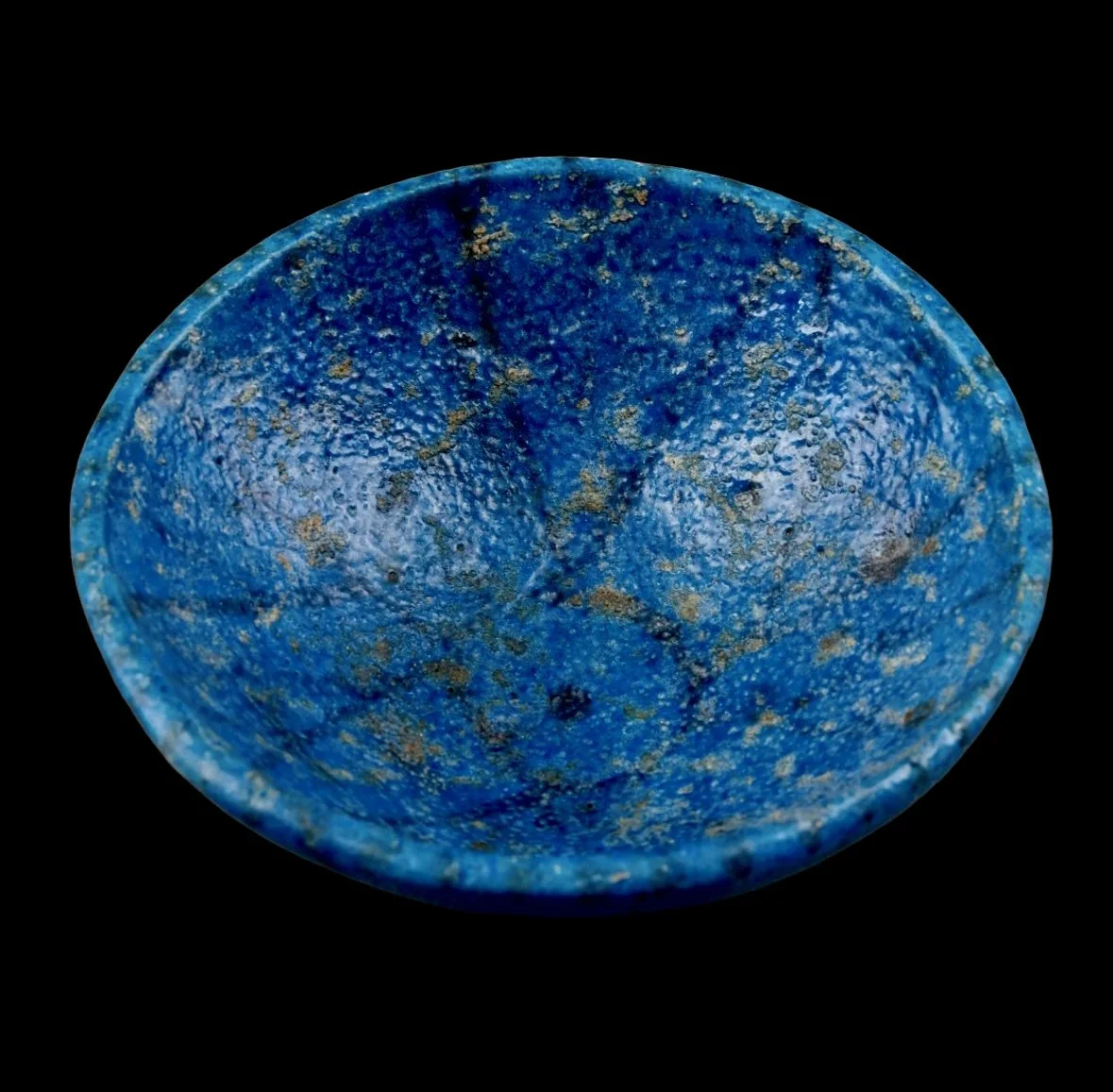
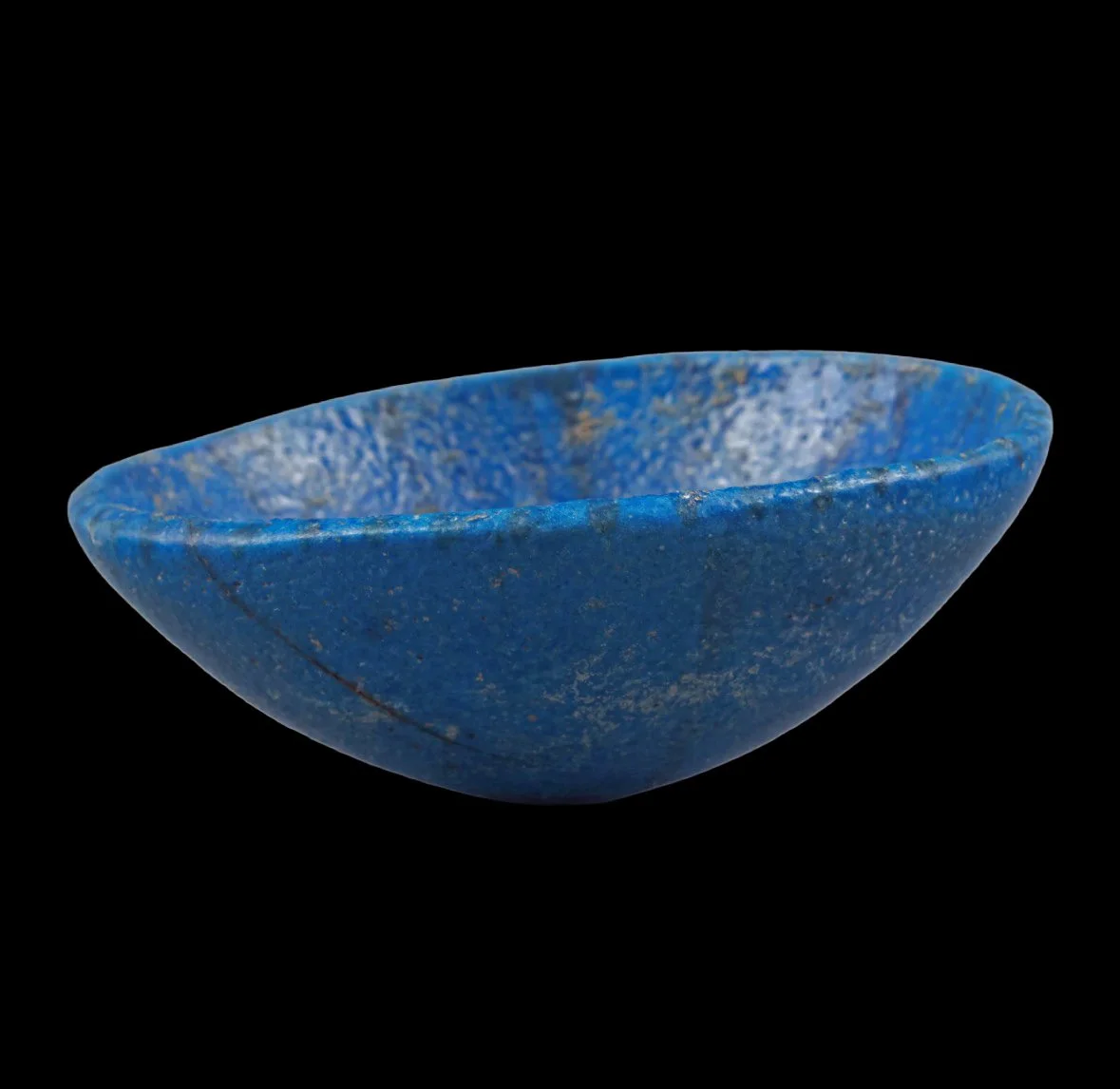
Ancient Egyptian deep blue faience Lotus bowl
New Kingdom, probably 18th Dynasty, circa 1550–1300 BC
Particularly attractive ancient Egyptian lotus bowl in deep blue faience, distinguished by its exceptionally rich cobalt-blue and turquoise glaze. The shallow, rounded body has a gently curving profile and a well-defined, slightly raised rim. Its interior displays a beautiful interplay of intense ultramarine and lighter turquoise-blue tones, enriched by irregular mottling and scattered sandy-gold and ochre-coloured mineral deposits. The lustrous yet textured surface, with its subtle variations in colour and naturally aged patina, gives the bowl considerable visual depth and character.
The lotus flower held a special significance in ancient Egyptian culture. The blue lotus, in particular, was associated with the rising sun, creation, rebirth and the eternal renewal of life. Its flowers opened with the morning sun and closed at dusk, making it a powerful symbol of regeneration and the cyclical nature of existence. The lotus motif consequently appeared frequently in Egyptian art, religious imagery and funerary objects.
Faience bowls of this type were valued both for their practical and symbolic associations. They may have served as small vessels for drinking, serving or presenting offerings, while similar vessels were also deposited in tombs as part of funerary equipment. Their vivid blue colouring evoked the life-giving waters of the Nile and the regenerative powers associated with the lotus.
An appealing example of Egyptian faience craftsmanship, combining a beautifully shaped vessel with the striking colour and symbolic significance of one of ancient Egypt's most enduring motifs.
Condition: Intact, with attractive age-related surface wear and patination.
Dimensions: Diameter 10 cm; height 5 cm.
Provenance: Dutch private collection; acquired at the Basel Art Fair.
Price € 3.500,—