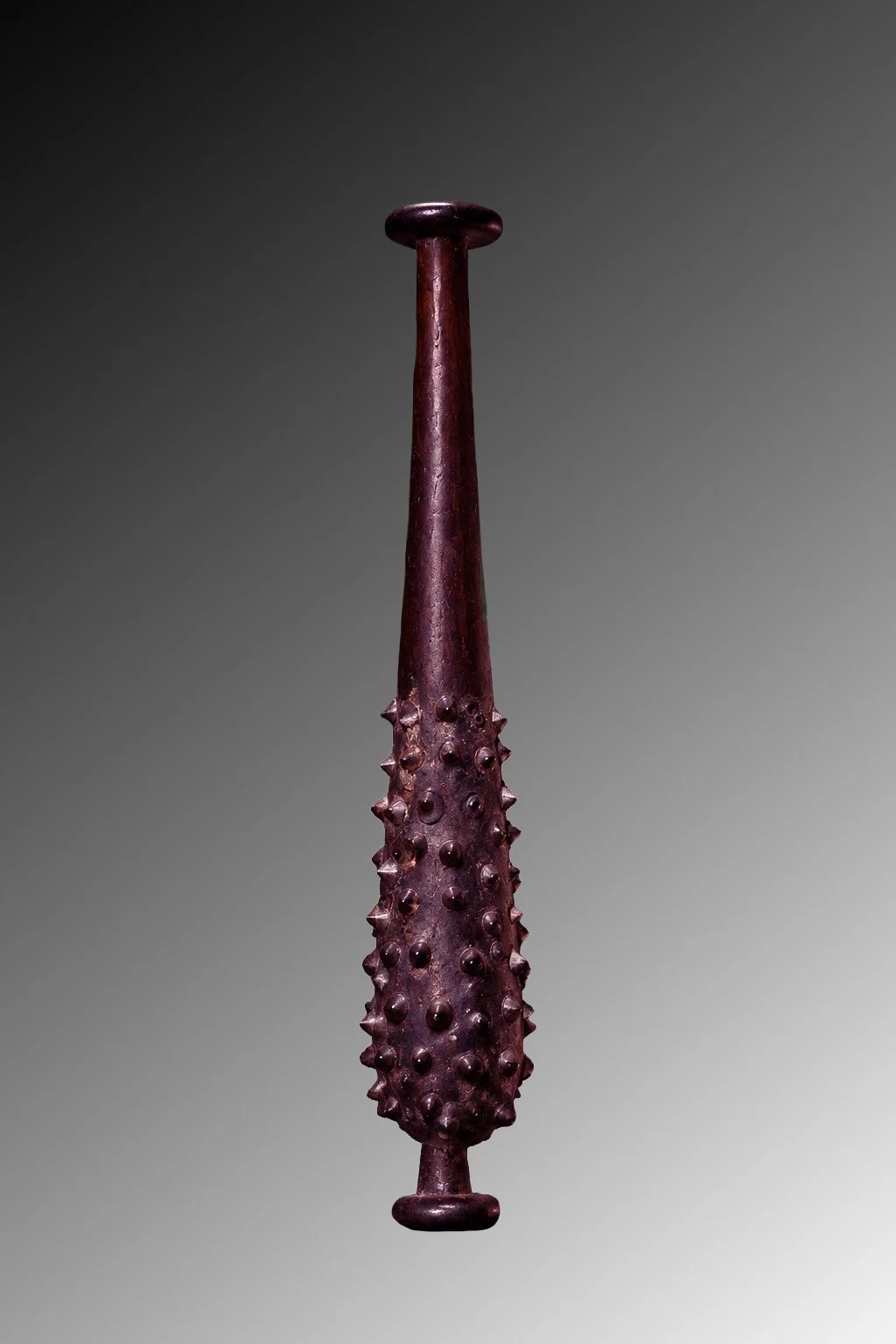
Roman aubergine glass Hercules club unguentarium
Isings 105 Warted Variant
A rare and highly decorative spindle / pipette unguentarium in the shape of the club of Hercules - Herculeskeulen-Fläschchen.
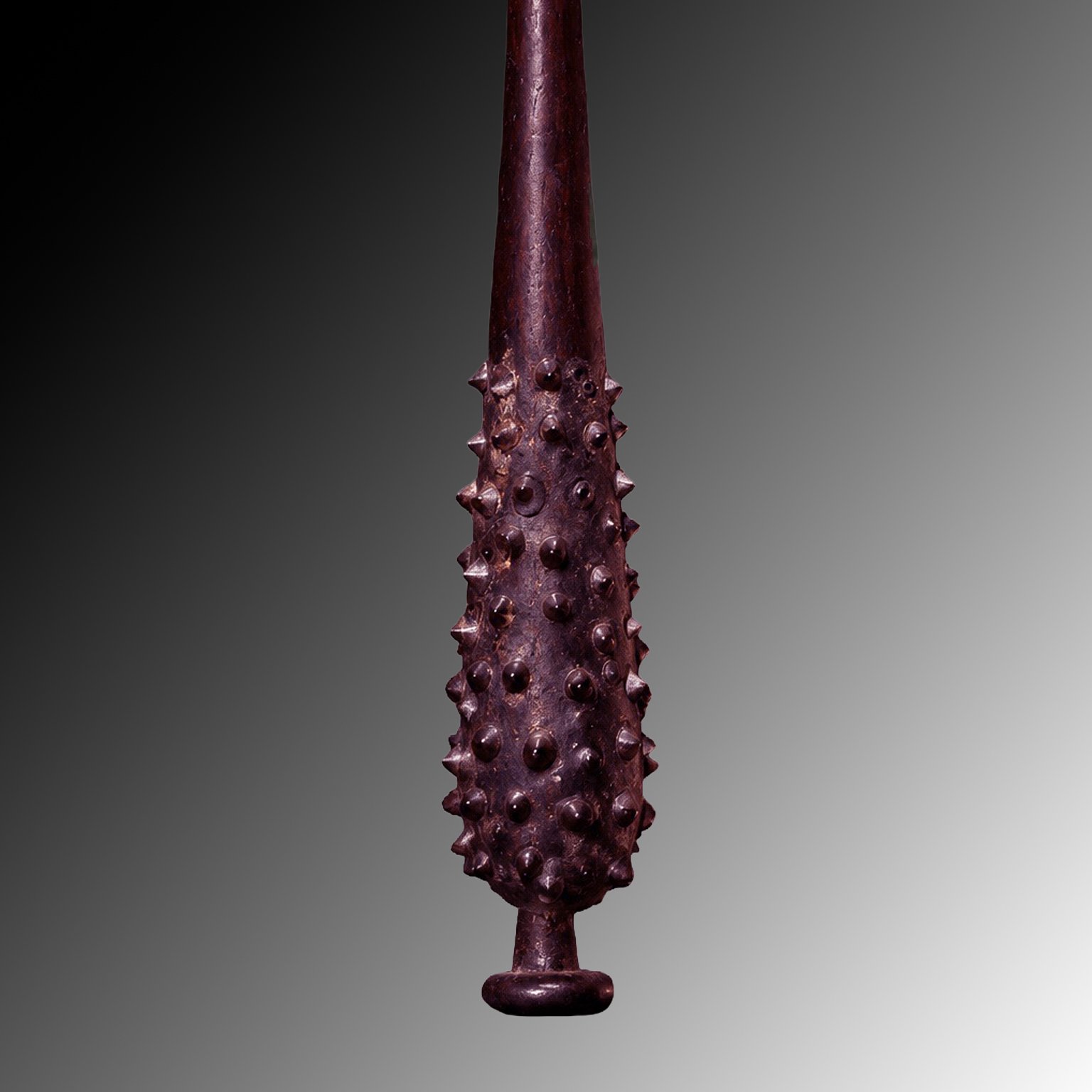
The flask is free-blown from an almost black glass that transmits a deep eggplant / aubergine purple when held to strong light, coloured by a high concentration of manganese. It has a long tapering pipette neck with a thick folded disk rim at the top and a smaller disk foot at the bottom, allowing it to stand on either end. The lower third is globular and completely covered with densely applied pointed prunts and rounded warts - the stylized knots of Hercules' club.
This type is often called Igelflasche / Warzenfläschchen / Noppenflasche. In Roman glassmaking, these applied glass drops imitated costly gold and silver vessels set with precious stones , a cheaper but highly effective luxury version for the middle class.
The piece belongs to the well-known Rhineland glass production of Cologne, one of the greatest centers of artistic glass creation in the late Empire. In this region, grape flasks and warted flasks were blown within the city walls in the early 3rd century and deposited as grave goods.
Parallels:
Isings Form 105 / Goethert-Polaschek Form 46b - Pipette unguentarium with wart decoration
Rheinisches Landesmuseum Trier, Nuppenbecher series Inv. G I G 607 - same wart technique
Römisch-Germanisches Museum Köln - glass vitrines, 3rd c. Cologne production, Hercules club and warted spindle bottles
Literature:
Isings, C. Roman Glass from Dated Finds, Groningen 1957, Form 105
Goethert-Polaschek, K. Römische Gläser und Glasschmuck aus Trier, Trier 1977, Form 46-48
Fremersdorf, F. Römische Gläser mit Nuppen- und Warzenauflage aus Köln
Culture: Roman, Rhineland
Date: Late 2nd - 3rd century AD, ca. AD 180-270
Workshop: Colonia Claudia Ara Agrippinensium (Köln / Cologne)
Material: Free-blown glass, manganese-coloured aubergine glass
Dimensions: H. 10.4 cm
Condition: Intact, with minor burial deposits and sinter between the prunts. No restoration. Beautiful iridescence. White encrustation in the recesses typical for a Rhineland grave find.
Provenance:
Found between Köln and Trier, Rhineland, Germany. Ex BAAF - Basel Ancient Art Fair, acquired a few years ago. Private collection,acquired at an estate sale.
Price € 3.250,—