Oil Lamp 006
Size: 11 x 8,5 cm
Period: Roman, c.200- 400 AD
Condition: Slightly worn
Provenance: Collection Bjarte Rekdal (b 1935)
The items were acquired in Tunisia between 1965-1966.
Price SOLD
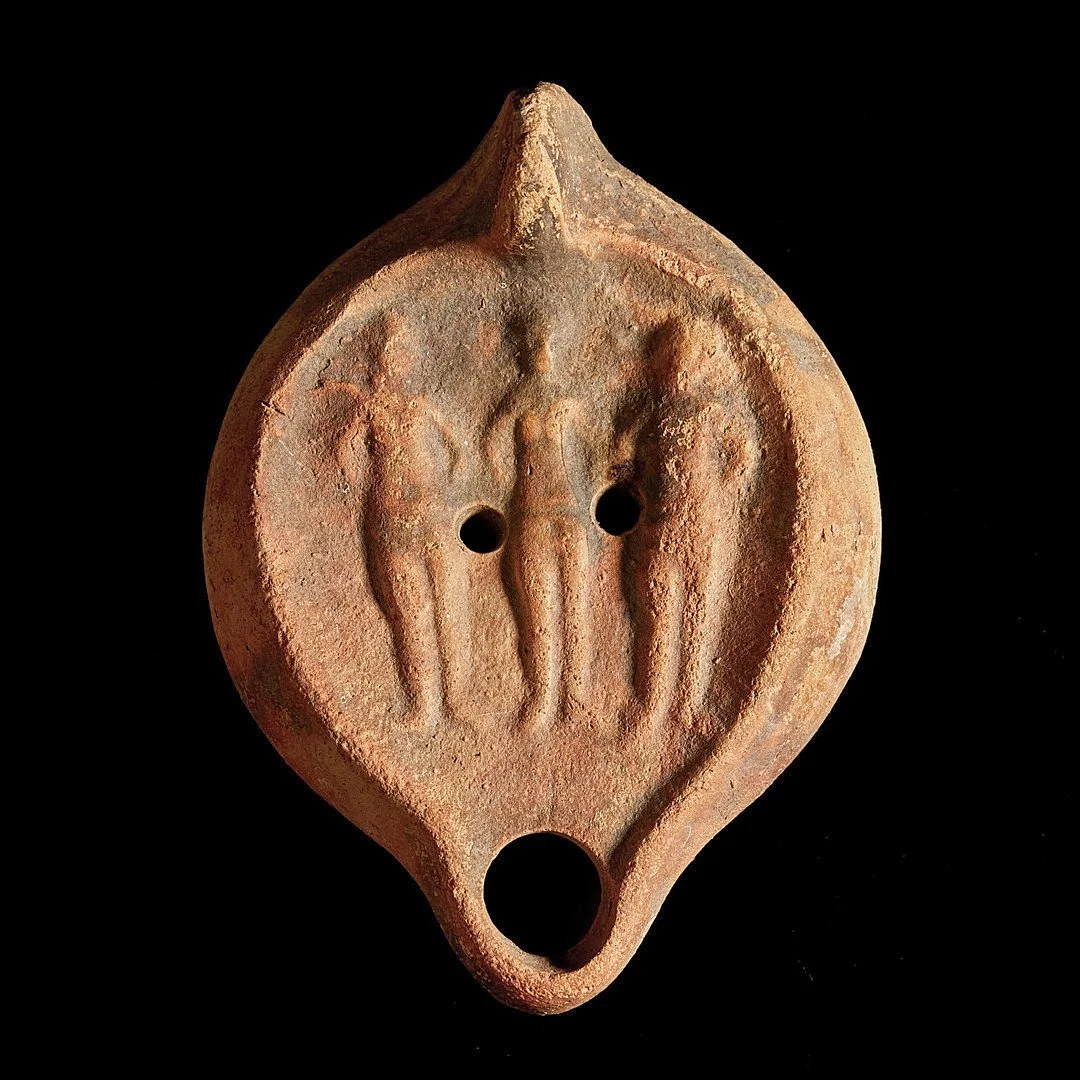
Roman Oil Lamp with Triade
This object is an ancient Roman terracotta oil lamp, molded in a reddish-brown clay and covered with a thin slip, typical of North African and Mediterranean Roman workshops of the 2nd–4th century CE. The lamp has a rounded, pear-shaped body with a projecting nozzle terminating in a circular wick hole, and two smaller openings on the upper surface that served as the filling hole and air vent.
The upper field (the discus) is decorated with a molded relief of three standing human figures, arranged side by side in a formal, frontal composition. Each figure is shown upright and elongated, with narrow waists, straight legs, and slightly broadened shoulders, giving them a stylized, almost column-like appearance. Their arms appear to be held close to the body, possibly folded or raised slightly, and the heads are small and rounded, with minimal facial detail, emphasizing symbolic rather than realistic representation.
This type of imagery is characteristic of late Roman and North African lamp iconography, where figures are rendered in a simplified, hieratic manner. Such triadic compositions often represent protective or sacred groups. They have been variously interpreted as:
Household protective spirits (Lares or local equivalents)
Worshippers or devotees standing in prayer
Regional or syncretic deities
Or figures from Christian or transitional religious symbolism in the later Roman period
The symmetrical grouping of three figures is significant, as triads were widely used in Roman, Punic, and North African religious imagery to express protection, continuity, and divine presence.
In use, the flickering flame emerging from the nozzle would have illuminated the three figures, making them appear animated in low light and reinforcing their protective or devotional role within a household, workshop, or shrine. The lamp therefore functioned not only as a source of light but also as a small religious or symbolic object, reflecting the spiritual and cultural world of Roman North Africa.