Oil Lamp 009
Size: 11,5 x 7 cm
Period: Roman/Byzantine Period | C. 400 - 600 AD
Condition: Repaired
Provenance: Collection Tyko Ringblom (1923-2018).
Price € 175,—
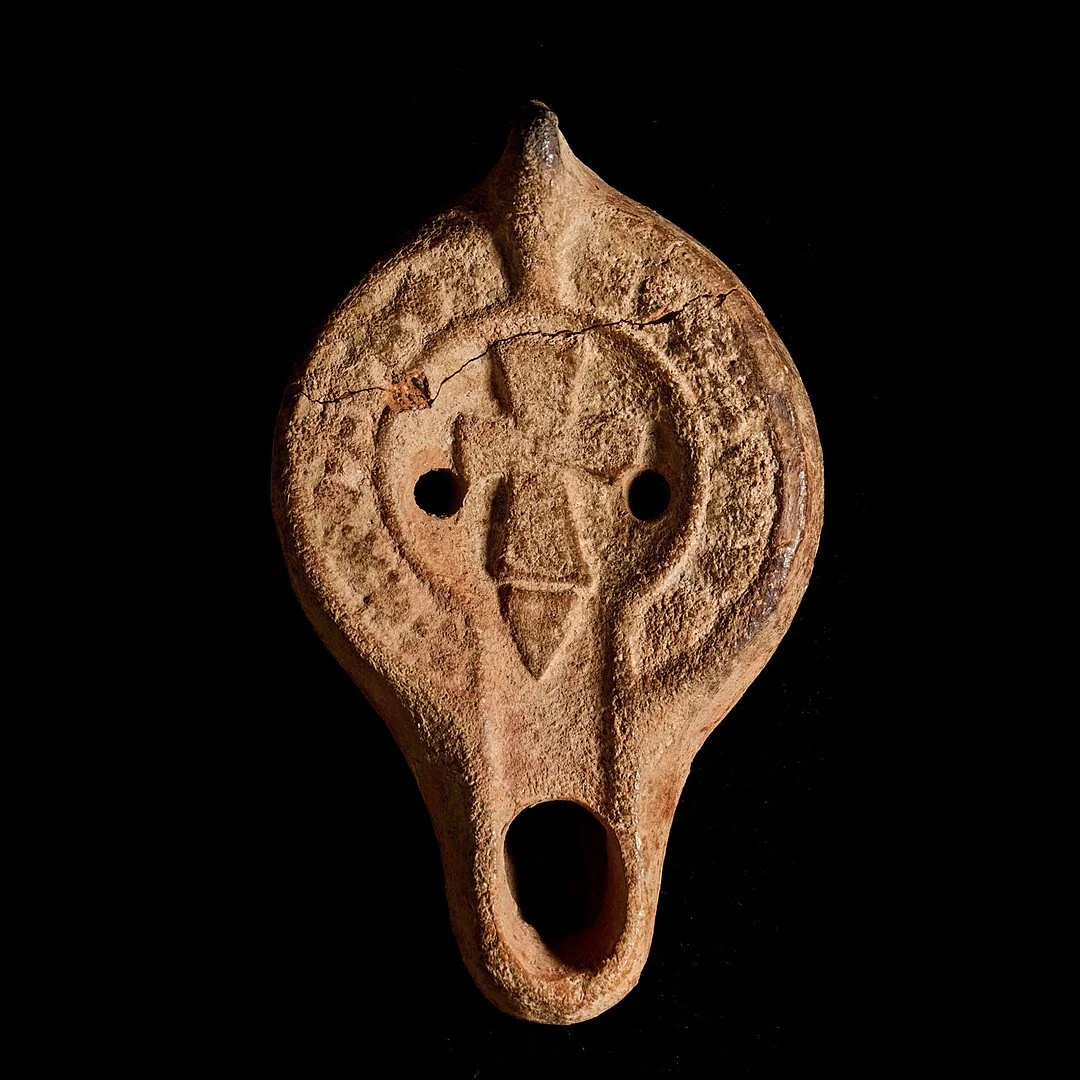
Terracotta Oil Lamp with Christian Cross Monogram
This mold-made terracotta oil lamp is a testament to the transition from the classical Roman era to the Christianized Byzantine Empire in the eastern Mediterranean, specifically from the Holy Land or North African provinces, major production centers for this style.
The lamp features an elongated, oval-shaped body with a single, unpierced lug handle at the back (not fully visible). The top of the lamp has a slightly sunken central area (discus), which is outlined by a raised ridge that extends to the wide, rounded nozzle, forming a broad channel. The body has two filling holes on either side of the central decoration.
The discus is adorned with a prominent Christian symbol known as a staurogram, a monogrammatic cross that combines the Greek letters Tau (T) and Rho (P) as an abbreviation for stauros, or "cross". The shoulders are decorated with a pattern of molded geometric motifs, likely stylized palm branches or triangles. Charring is visible around the wick hole at the nozzle, indicating historical use.
Christianity was the predominant religion in the Byzantine world, and this is strongly reflected in the use of religious imagery on everyday objects like lamps. These lamps provided essential light for domestic use but also held significant symbolic meaning, connecting the practical function of illumination with the Christian metaphor of divine light. They were often sold to pilgrims as souvenirs from sacred sites or placed in graves as votive offerings to provide light for the deceased's journey to the afterlife.