Oil Lamp 010
Size: 13 x 7,8 cm
Period: Roman North Africa (Tunisia), c. 200 - 300 AD
Condition: Slightly worn
Provenance: Collection Bjarte Rekdal (b 1935)
The items were acquired in Tunisia between 1965-1966
Price € 350,—
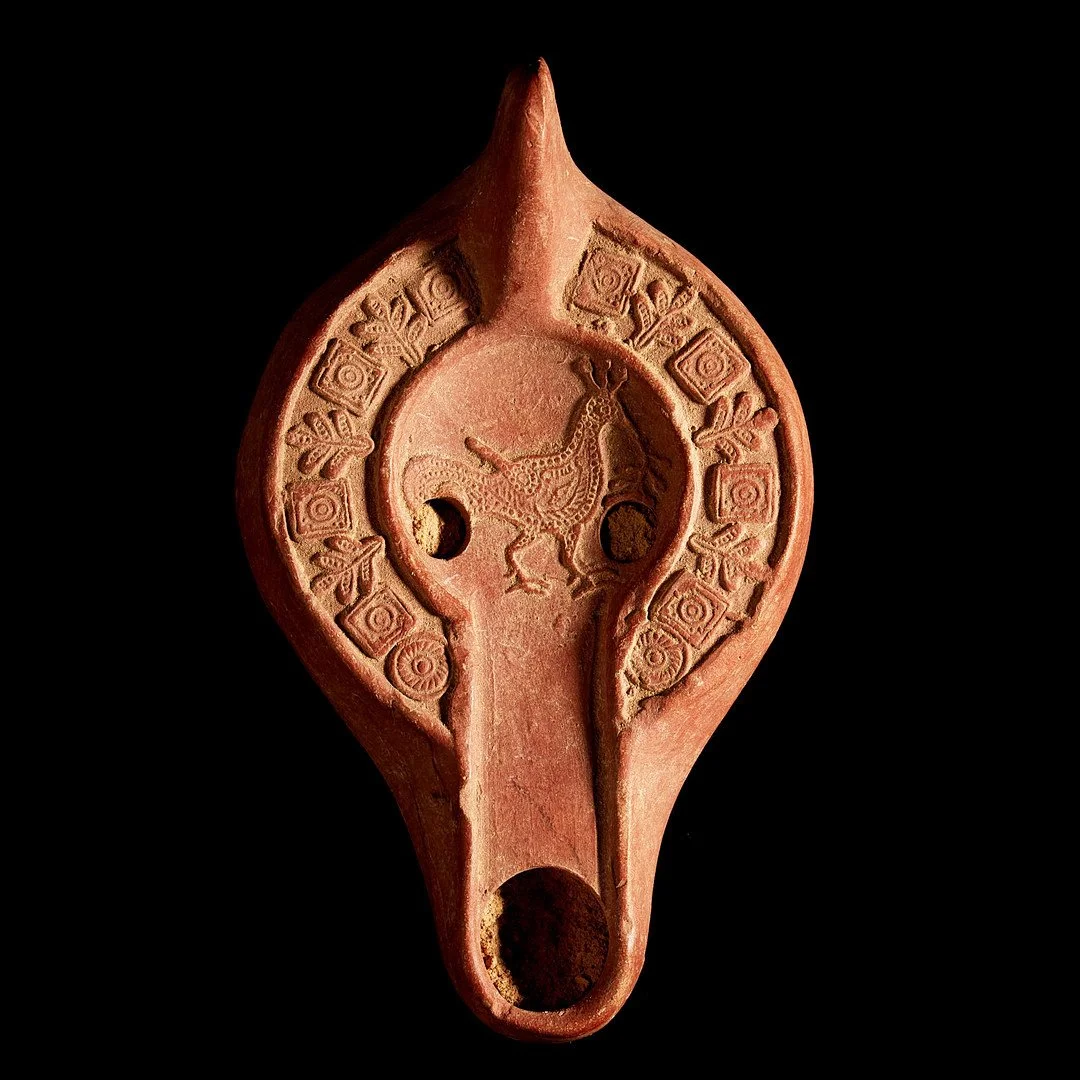
Terracotta Oil Lamp with Bird (Rooster) Motif
This terracotta oil lamp is a characteristic product of Roman North Africa, one of the most important lamp-producing regions of the Roman world. Workshops in what is now Tunisia, particularly around Carthage and central coastal towns, exported vast quantities of finely made lamps throughout the Mediterranean.
The lamp has a rounded body, an elongated nozzle, and a tall, flame-shaped rear handle. A central filling hole opens in the discus, flanked by two smaller air vents, while the wick emerged through the rounded aperture at the tip of the spout. The clean symmetry and carefully defined mold lines reflect standardized production in a professional workshop.
At the center of the discus is a bird (rooster) shown in profile, standing alert with raised head and extended tail. In Roman symbolism the rooster was associated with vigilance, the victory of light over darkness, and protective forces that warded off evil. Its placement on a lighting device would have reinforced the lamp’s role as a bringer of illumination and safety within the home.
The surrounding decorative band of rosettes, geometric squares, and stylized vegetal forms is typical of North African lamp design, where dense ornamental borders were favored over open fields. The reddish-orange clay and crisp relief are consistent with Tunisian fabrics and firing techniques.
Used in homes, workshops, and shrines, lamps such as this were everyday objects, yet they also carried symbolic imagery and regional artistic identity. This example illustrates how Roman North Africa combined mass production with rich decorative and cultural expression..