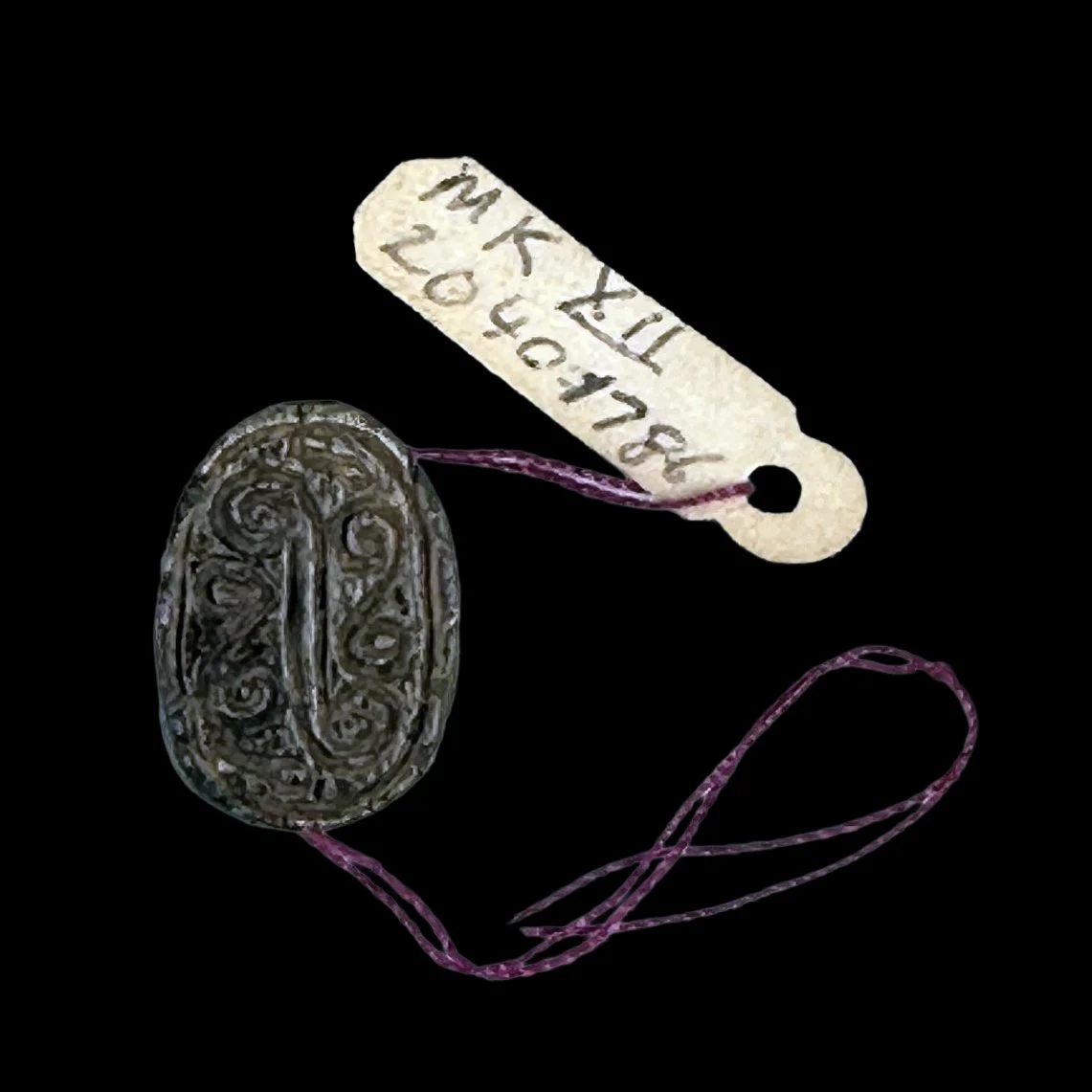
EGYPTIAN STEATITE SCARAB WITH SCROLL AND URAEUS DESIGN
Middle Kingdom to Second Intermediate Period, ca. 1850 - 1600 B.C.
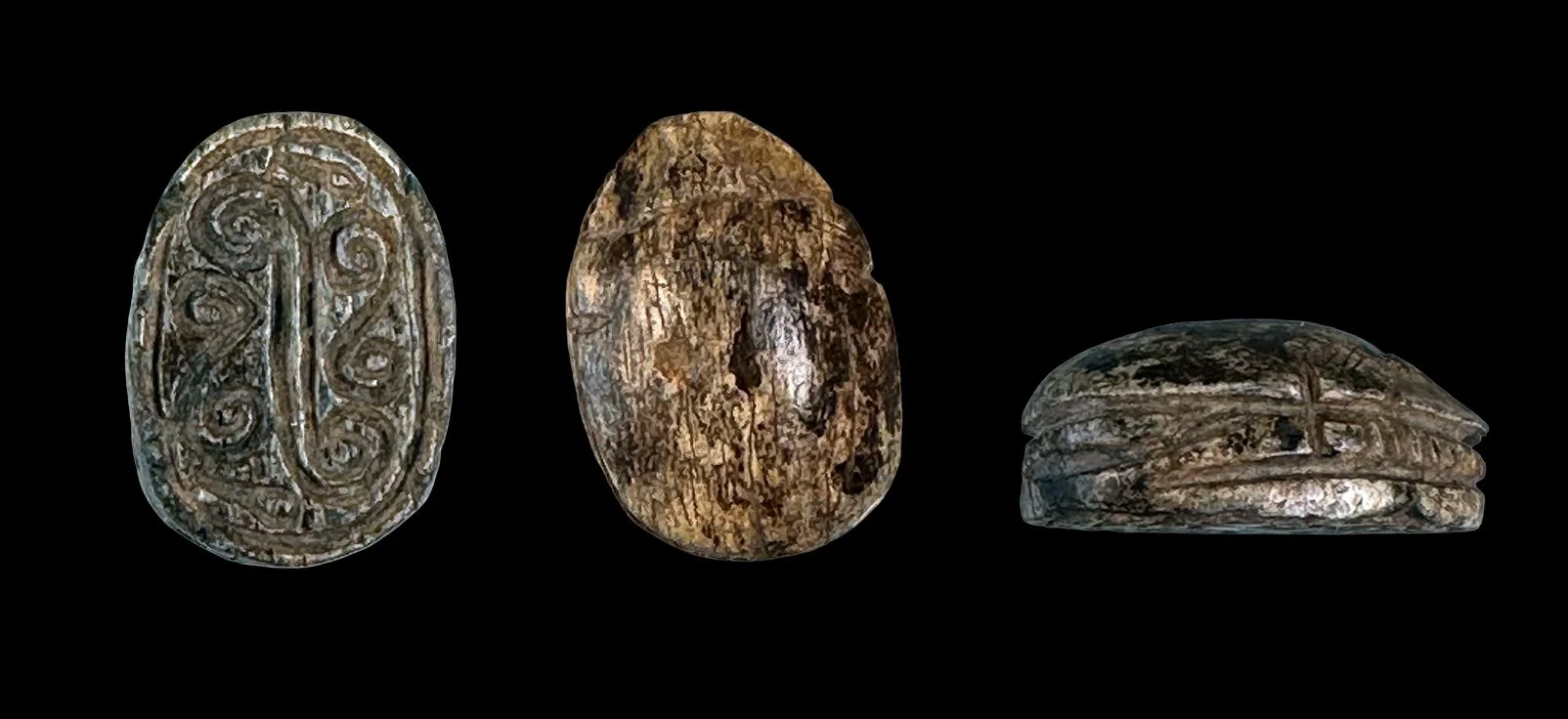
A finely carved steatite scarab of classic form, with detailed head, clypeus, prothorax and side plates with humeral callosities clearly defined. The back shows well-preserved longitudinal striations from carving. Pierced longitudinally for suspension as an amulet or seal.
The base is deeply engraved in fine intaglio with a symmetric scroll pattern framing a central vertical column, surmounted by a uraeus cobra facing right. The scroll motif, developed in the late Middle Kingdom, symbolizes continuity, protection and cyclical rebirth, while the uraeus - the sacred cobra goddess Wadjet - adds royal protective power. This combination is one of the most characteristic apotropaic designs of the Second Intermediate Period and was worn both as a protective amulet for the living and as a seal.
Material: Glazed steatite, dark brown to grey-black with white glaze remnants in recesses
Dimensions: 1.5 x 1.0 cm (15 x 10 mm)
Weight: 3 grams
Condition: Very good to excellent. Surface with age-appropriate wear and minor encrustation as expected. Intaglio remains deep, crisp and fully legible. Complete and intact, with original patina undisturbed. Preserved with original old collection tag inscribed "MK XII 204078" attached with burgundy thread.
Provenance:
Donald Wonder Collection (1938-2023), California & New Jersey, USA
Acquired over decades of collecting, thence by descent.
With old collection tag "MK XII 204078"
Parallels:
Cf. Petrie, Scarabs and Cylinders with Names (1917), Pl. X; Tufnell, Studies on Scarab Seals Vol. II, scroll class 3B.
Price € 250,—